Hands Off My Tittle!

It’s not as dirty as you think.

Some words just sound naughty, even if they aren’t. Take “jot” and “tittle”. They always make me think of someone snickering, “Yeah, I’d like to jot her tittle . . . .”

But no, they’re not only squeaky clean (well, mostly, there’s a naughty definition of “jot” you’ll have to look up yourself), they’re also quite interesting.

Anyway, let’s look at the old-school definition. In Matthew 5:18, Jesus said, “For verily I say unto you, till heaven and earth pass, one jot or one tittle shall in no wise pass from the law, till all be fulfilled.”

So what is a “jot”? It means the smallest part of the alphabet, the least letter, the smallest bit of writing. So if you say you’re jotting something down, you ain’t writing a dissertation, honey. If you want to insult someone and leave them confused at the same time, just say, “That don’t make a jot of sense.” It is related to the word “iota”, which we’re all familiar with.

A “tittle” is a dot, stroke or point in writing, like the dot over an i or a j, or the cross (no pun intended) over a t.

So there ya go.

Comments? Questions? Leave ‘em below.
I’ve Decided That I Will No Longer Run Farther Than 5k at a Time

“Further and “farther”; what’s the diff?

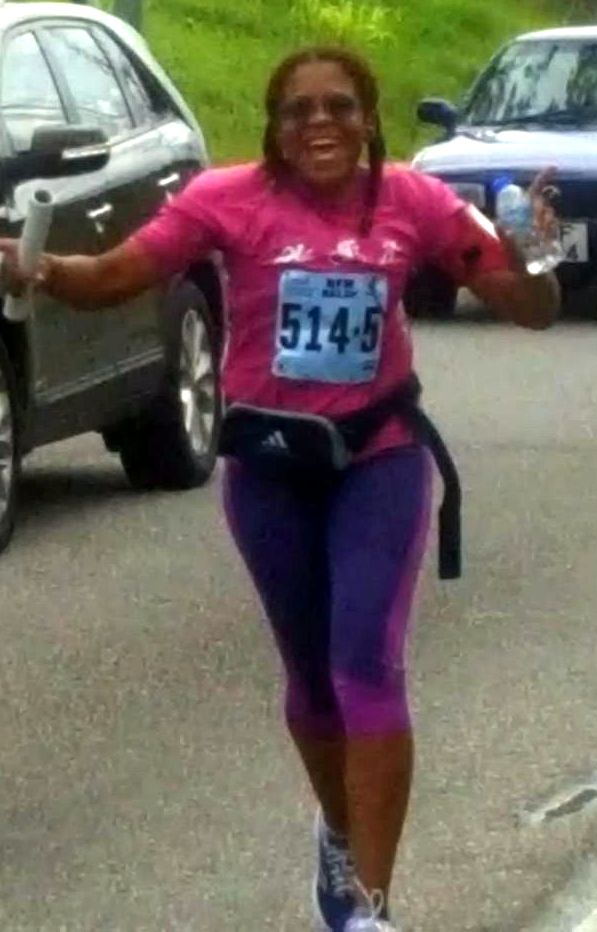
Photo of Roslyn running a marathon relay
On the home stretch

Furthermore, I’m not running more than once a week.

Like hell.  Anything less than 5K is for wusses, and I’d die if I could only run once a week. But let’s talk about FARther vs FURther. It’s really easy.

FARther refers to physical distance, a space you can literally travel across. As in, “How much farther do we have to go?”

FURther refers to theoretical ground, usually applied to concepts, conversations, arguments, etc. For example, “Nothing could be further from the truth.” Since the truth is not a physical entity, and can’t exist in literal space, you can’t actually measure how far anything is from it.

Need I take this any further?

That’s my two cents. What’s yours? Leave a comment.

Hi, Mom!

When free-range capital letters should come home to roost.

Funny enough, one of the most common errors I come across when I’m editing is one of the simplest, and one that we all learn very early in primary school. It has to do with the capitalisation of proper nouns vs common nouns.

There are a lot of instances in which people make mistakes, but the one I want to deal with today has to do with family relationships, and how we refer to our parents, aunties, uncles, etc.

There’s a tendency to capitalise the word Mom, for example, regardless of the context. But remember that if we’re using the word generically, there’s no need to capitalise. If it’s a form of address, we do. Meaning you say: “Is that your mom over there?” (No capital M as you are referring to the person, not addressing them, and there are a dozen moms in the room.)

But we say, “You make the best shepherd’s pie in the world, Mom!” (Because you’re talking to the person. And yes, I do make the best shepherd’s pie in the world.)

You can also be talking about the person but using their title, as in, “Did you ask Mummy if you can sleep over this weekend?”

The same goes for other relationships. You say, “Your auntie is on the phone,” but you also say, “Auntie Aggie is on the phone”.

We cool now? Good.

Join the conversation. Please leave a comment.

The Longest Word

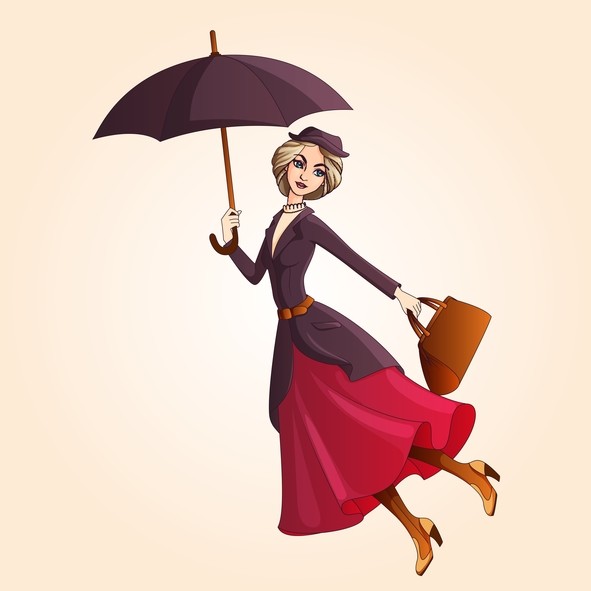
Cartoon of Mary Poppins floating through the air with her parasol.

I’m going to stick an earworm into your ear, and once it’s in, it will be the devil to get out. Here goes: supercalifragilisticexpialidocious. You can hear the music in your head now, can’t you? Dum-dee-dee-doo-dah . . . . You can thank me later.

While it is one of the longest words in the English language, it certainly isn’t the longest. There are a lot of contenders for that, such as pneumonoultramicroscopicsilicovolcanoconiosis, which is a type of lung disease caused by inhaling ash and dust. And that, my friends, is why I decided not to go into medicine.

(Info sourced from grammerly.com)

What’s your view? Leave me a comment.

Pangrams

A sentence that contains all 26 letters is called a pangram. The best known one is “The quick brown fox,” yada yada, but there a few lesser known ones, like:

  • The five boxing wizards jump quickly. (Great if you’re a Harry Potter fan)
  • Jinxed wizards pluck ivy from the big quilt. (Also seriously Potteresque)
  • Crazy Fredrick bought many very exquisite opal jewels.

Between you and me, making up pangrams is a great way to pass time in a boring meeting. You look quite serious, and you’re writing stuff down, so you have to be working, right?

Do you think you can come up with one? Post it in the comments below. Found a good one online? Post that, too.

(Info sourced from HowStuffWorks.com)

Wanna talk about it? Leave a comment below.

Don’t Call me Rosalyn

Nothing more irritating than seeing your name misspelled in print.

One of the most common errors I meet when editing is the misspelling of names. Even seasoned writers do it, and it drives me nuts. I frequently receive stories in which the subject of the interview is spelled wrong. Honey, with name spelling trends being what they are, I’m not ashamed to ask you even if your name is Jane . . . just in case you spell it J’ain.

The problem is so common that whenever a story comes across my desk for editing I Google all the names in it—even brand names. And my hit rate is shocking.

Why, people? It’s such an easy problem to solve. Just Google it! Or check Facebook. They’ve got 1.7 billion users; don’t you think there’s a good chance you’ll find your subject there? Check things like punctuation and unusual variation, too. Is it Williams Auto or William’s Auto? Shops or Shoppes? 

It only takes about 30 seconds to avoid embarrassment that will haunt you in print for months . . . or in cyberspace for a lifetime.

I’ve done my part. Now it’s your turn. Leave a comment below.

Feeling Sorry for Satan

Nobody’s 100% anything. Not even the bad guys.

We all love a good villain. But too often writers try so hard to make the antagonist come across like a bad guy that they forget to make them human. They forget to add nuance and texture to their characters.

Remember that most bad guys don’t think they’re bad. They see themselves as the good guys. They believe their fight is just. A good, memorable, well-written villain isn’t pure evil; leave that for Saturday morning cartoons.

Insurgents believe they are fighting a just war. They think they’ve been wronged. They retaliate.

Sympathetic traits give your villain dimension. They make him relatable. Now, note that you don’t have to like a villain, or root for him, for him to be sympathetic. He simply has to have strong human traits that you can identify with. No matter how atrocious the acts he commits are, he believes he is justified. In spite of yourself, you recognise his humanity.


Hannibal Lecter was erudite, charming, and learned—and he spared Jodie Foster’s life. Ra’s Al Ghul believed that Gotham was inherently corrupt and hypocritical, and needed to be cleansed. Satan got his feelings hurt.


Say what, now? Yes, THAT Satan. He wanted to be the most beloved, and he was not. He wanted to be top dawg, but simply didn’t have what it took. He was cast out of heaven, and when he hit the ground, he hit hard. It hurt. So he retaliated.
Poor guy.


Sit down and think of three good reasons to feel sorry for Satan. If you can do that, you’re well on your way to developing the sensitivity that breeds great, three-dimensional characters.

Please comment below and let us know what you think.

Billylovesboobs

Enough with the sophomoric email addresses. Grow up!

Would you do business with someone with an email address like billylovesboobs@whateverthehell.com? Well, maybe I would, if the pay were right, but still . . . .


Your email address is one of the first things people see about you, and when you’re doing business, it must reflect positively on you. Too many times I get professional communiques from people with email addresses that graphically describe their physical attributes, their flair for obscene or misogynistic language, or their sexual proclivities. Which I do not want to know about, especially if we’re talking business.


Take it from an old pro: get yourself an email address that you’d be proud to email the President from. Maybe just your name, (with a twist if that’s already taken), the name of your business, or some quality or attribute that sells.


Keep the dirty-word email addresses for when you’re chatting with your homies, or signing up with porn sites. Got that, miss lusciouslips@memail.com?

Comments and questions, guys. Let’s talk it through!

Why Editors Need to be Edited

We all screw up. Sometimes, spectacularly.

Have you spotted an error on my site? If so, I’d be grateful if you’d point it out to me. I try very hard not to mess things up, but I’m only human. I make mistakes.

That’s why even editors need editors. Want an example? I once wrote in a document, “The sector will weather the storm and emerge un-buttered.”

*hangs head in shame

Wait! You aren’t leaving without leaving a comment, are you?