raNDom cApitALisaTION should be a Criminal Offence.

Too many capital letters spoil the alphabet soup.

When I’m editing, this makes my top 5 search and destroy list. And Trinis love capitals. We use them to make things sound exciting. “He had a Heart Attack!” “Our Furniture is Half-Off!” Arbitrary capitals hurt my eyes!


We use them as a gesture of respect: “My Mom is a Doctor.” No, honey, your mom is a doctor. It’s just a profession. No capital needed. You can, however, say, “Doctor Bennet is my mother.” Because then you’re using her professional designation as a title.

Also, did ya see how I didn’t use a capital letter on ‘mom’? When you’re referring to someone in the third person, you don’t say “my Mom”. You use lower case letters. “My mom” or “my dad”.

When you’re speaking to them, however, it’s all good. Say, “Mom, did you make dinner yet?” or, even better, “Mom, we made dinner!”

What do you think? Leave a comment and let’s talk.

Lost M&M

No M&M left behind.

You know how the Bible says that if a shepherd has lost one sheep, he’ll leave the other 99 and go searching for it?

Well, if I lose one M&M, I’ll leave the others on the pack and get down on my hands and knees to search under my desk until I find the one I dropped!

(It was delicious.)

Wait! You aren’t leaving without leaving a comment, are you?

Wild Herds of Punctuation Marks on the Loose

We’ve lost control of our keyboards. Punctuation marks have taken over!

Cartoon of snakes shaped like a question mark and an exclamation mark.
They’re on the loose!

Perhaps it’s due to global warming, or maybe overpopulation, but have you noticed that punctuation marks which once roamed the wild like lone wolves have taken to grazing in herds? Multiple question marks terrorise the neighbourhood. Why????

And those exclamation points!!! Oh my God!!!! They’re everywhere!!!!

Call me old-fashioned (but don’t call me old), but I kinda think your writing should be strong enough that just one punctuation mark should suffice. Instead of saying OMG!!! I love you!!!, how about finding a fresh, endearing and memorable way to do it instead?

Excited to hear your point of view. Leave a comment below.

Never, Never, Never Start a Sentence With ‘And’

Time to toss out the old “rules” we never should have had in the first place.

Or ‘but’. Or ‘so’. Or any number of co-ordinating conjunctions that join two sentences. You know what else I want to start a sentence with? ‘Bite me’. Well, to be honest, that’s a complete sentence, but you get my drift.

There is nothing wrong with starting a sentence with any of these words, including or,
nor, for, so, and yet. It used to drive me batshit when editors went at my novels with hammer and tongs and started shredding my story, all to satisfy some mythical ‘rule’ that doesn’t exist.

When we were in primary school the teachers taught us that these words could only join sentences, for example: “You’re ugly, but I totally like you anyway,” or “Roslyn Carrington is the greatest writer of her generation, and damned if she isn’t horrendously underpaid.”

That was their way of teaching you to write complete sentences, and helping you stop writing phrases thinking they were full sentences. In other words, it was like rubbing aloes on your fingertips to stop you from biting your nails.

But, now that we’re all grown up, let’s recognise that we don’t need these training wheels for our sentences anymore. Your sentence will trot happily along if you start it with a conjunction, and the grammar police won’t put you in shackles.

And to quote Forrest Gump, that’s all I got to say about that.

Comments? Questions? Leave ‘em below.

I’m a Total Whore for the Oxford Comma

A comma before “and”? Call the police!

Also called the serial comma, it’s the comma at the end of a list that comes before the word “and” (and sometimes “or”). A comma before “and”? Good God, is the world coming to an end?

We’ve all been taught that putting a comma before “and” will make your hand fall off. My Common Entrance lessons teacher used to say, “You can’t put a comma before ‘and’ because ‘and’ is a comma.” I’ve even had clients call me up, gagging, “Miss! You put a comma before ‘and’!”

Which is why I can’t control a naughty giggle when I use one–which is often. Makes me feel like a rebel.

But the serial comma is very useful for clarifying items in a list. If the items in a list are clear, you don’t need it: “I bought new towels, sheets and pillowcases.” But when it gets confusing, when it is hard to know if the last two items are separate entities or go together, you use it. “The only people who came to my party were my brothers, Machel and Keith Rowley.” Sooo, are Machel and Keith my brothers? Maybe if I said “my brothers, Machel, and Keith Rowley” it would be clearer.

Anyhow you slice it, love ‘em or hate ‘em, be consistent. Use serial commas throughout your piece where applicable, or don’t use them at all.

That’s my two cents. What’s yours? Leave a comment.

Pubic Relations

The best way to proofread is in print. That way the eye isn’t fooled. Better yet, let me proofread for you!

You’d be shocked if you knew how frequently I have to deal with careless, sloppy work delivered by full-time, professional writers. Apart from the frustration I feel, there is a sense of disbelief . . . if you make your living writing, shouldn’t you at least take pride in your work, and do whatever it takes to make sure it reaches the editor with as few errors as possible?


Everyone makes mistakes, myself included. This is why even editors need to be edited. But at the very least, whether you are a professional or an amateur, or simply have a paper to hand in or a memo to send out, please, proofread your work.

And the best way to do this is to print it out and read it with a red-ink pen in your hand. Why? Because the computer screen is a liar. It causes your brain to fill in the blanks, to see what you expect to see, not what is really there.

Paper, however, is brutally honest. It shows up flaws like litmus. We grew up reading on paper, not screens, so our brains aren’t fooled. So if what you’re writing is important, please print it out and read it before you publish it. That way you won’t get caught writing about “pubic relations” when you meant to say “public relations”.

Join the conversation. Please leave a comment.

Let’s Put Our Proverbial Best Foot Forward

It’s time to beat up (or beat down) tired old clichés and throw them in the garbage where they belong.

… and never use the word ‘proverbial’ again.

“She was lit up like the proverbial Christmas tree.”

“He was the proverbial black sheep.”

The second you write ‘the proverbial’ in your copy, what you’re essentially saying to your reader is, “Hear what, the next thing to come out of my mouth (or keyboard) is gonna be a pack of crap. Why don’t you just zone out for a few sentences, or skip ahead?”

Nothing good comes after ‘the proverbial’; only some tired, beat-down old cliché. So why bother? There are only three good reasons for using a cliché:

  1. Characterisation – If you’re trying to show that your character is a stagnant, boring old fart, have him speak in clichés.
  2. Irony – Wink, wink, me so funny. I’m so cool, I can talk in clichés and get away with it.
  3. Deadlines – If you go to print in half an hour, and you have no other way to express what you want to say, go brave, my friend.

Either avoid clichés outright, or, if you’re imaginative enough, embrace it, marry it, and bring forth a bunch of weird and interesting babies. In other words, change up the cliché to make it new again, like a coat of paint on a dingy wall. Why not put your best tentacle forward? Or your best pseudopodia?

Until then, ditch the clichés. Before I put a proverbial bullet in my proverbial head.

What’s your view? Please leave me a comment.

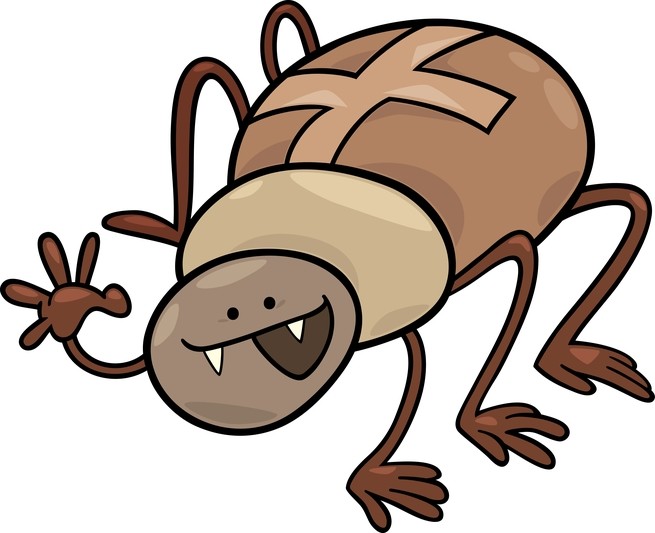
This is a Brown Recluse Spider

Words that sound alike are easy to confuse. Think how smart you’ll look when you get them right!

A cute cartoon of a brown recluse spider, waving Hi.
Doesn’t look so reclusive to me!

So named because of its shy and retiring nature, and its penchant for hiding under toilet seats. If you are reclusive, it means you avoid social interaction.

But I heard on the news an official saying he was “reclusing” himself from certain proceedings. No, good sir, you are “recusing” yourself. This means you are voluntarily withdrawing from a matter because of circumstances which could impact upon your impartiality, like a judge presiding upon her child’s court case, or a surgeon operating on his wife.

So, recluse = that weird, sorta smelly fella living 3 houses down, who has no friends and never says good morning to anybody.

Recuse = doing the honourable thing, removing yourself on principle, a rarity in politics, but let’s not go there!

And by the way: 1) “recluse” is not a verb, and 2) a brown recluse spider probably can kill you, but most of the time it’ll just leave you wishing you were dead.

What’s the Difference Between a Fugu Fish and a Mapepire?

Lots of people confuse words that they think mean the same thing. Keep your dictionary handy so you don’t fall into this trap.

Easy. A fugu fish will kill you if you bite it, and a mapepire will kill you if it bites you.

There’s a difference between poison and venom that few people pay any mind to. You hear that someone was “bitten by a poisonous spider”. There was even one unfortunate newscaster who announced that someone was “stung by a poisonous snake”. (A new species, I presume.)

Remember: poison is ingested, (or inhaled, or even soaks through the skin). But most of the time, you have to eat it for it to affect you. Some creatures have evolved a toxin that dissuades predators from eating them, like the poison dart frog. There are also poisonous mushrooms (not to be confused with ‘shrooms that could make you very, very happy).

Venom is produced by some creatures, like spiders, snakes and wasps, as a weapon. They can inject it into your system using their stinger or fangs. Venom probably isn’t something you’re likely to eat.

Got it? And next time you venture outdoors, beware of those stinging snakes!

What’s Your Currency?

Why do your readers come to you? Why you and not someone else? Because you give them what they’re looking for.

Currency is just a means of barter. It doesn’t have to be money. You can trade beads for blankets. A sack of peas for a sack of potatoes. As a writer, you also have to know what your currency is.

First, what are you offering? Why are people reading you?

  • You’re funny. They’re looking for a laugh.
  • You’re knowledgeable. You know something we plebes don’t, and are willing to share the information.
  • You’re exciting. You can get our pulse thumping.
  • You’re trying to convince us of something, to rally us to war.
  • You disagree with us and want to change our mind.
  • You have files to buss and we just dying to hear the scandal.

Now, what do you want from us?

  • Money. Ain’t nothing wrong with that!
  • You want to change the world.
  • You want to rule the world.
  • You want our approval.
  • You like to make people laugh.
  • You’re collecting Likes. Ain’t nothing wrong with that, either. Go ahead, Like this post. No, seriously…Like. This. Post. Comment, if you feel like it.

Whatever your currency is, whatever you’re giving so you can get something in return, doesn’t really matter. (Except for the Comments. COMMENT ON THIS POST!)

What matters is that you are clear on your objectives, and make the clear to our reader. Otherwise, we’re both gonna be disappointed.