Let’s Put Our Proverbial Best Foot Forward

It’s time to beat up (or beat down) tired old clichés and throw them in the garbage where they belong.

… and never use the word ‘proverbial’ again.

“She was lit up like the proverbial Christmas tree.”

“He was the proverbial black sheep.”

The second you write ‘the proverbial’ in your copy, what you’re essentially saying to your reader is, “Hear what, the next thing to come out of my mouth (or keyboard) is gonna be a pack of crap. Why don’t you just zone out for a few sentences, or skip ahead?”

Nothing good comes after ‘the proverbial’; only some tired, beat-down old cliché. So why bother? There are only three good reasons for using a cliché:

  1. Characterisation – If you’re trying to show that your character is a stagnant, boring old fart, have him speak in clichés.
  2. Irony – Wink, wink, me so funny. I’m so cool, I can talk in clichés and get away with it.
  3. Deadlines – If you go to print in half an hour, and you have no other way to express what you want to say, go brave, my friend.

Either avoid clichés outright, or, if you’re imaginative enough, embrace it, marry it, and bring forth a bunch of weird and interesting babies. In other words, change up the cliché to make it new again, like a coat of paint on a dingy wall. Why not put your best tentacle forward? Or your best pseudopodia?

Until then, ditch the clichés. Before I put a proverbial bullet in my proverbial head.

What’s your view? Please leave me a comment.
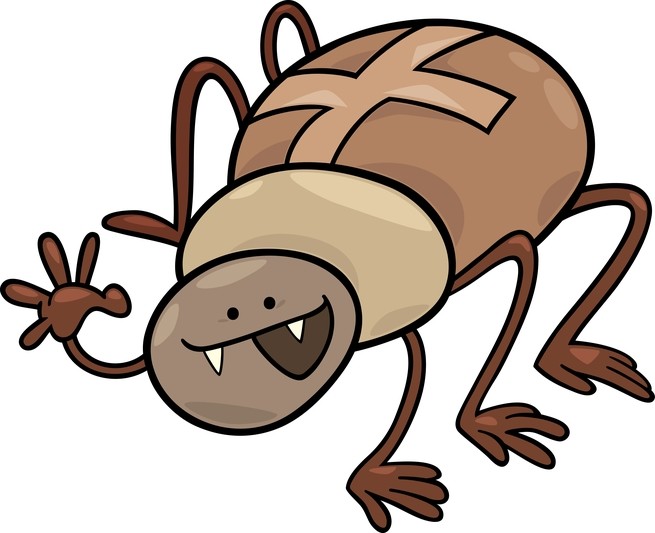
This is a Brown Recluse Spider

Words that sound alike are easy to confuse. Think how smart you’ll look when you get them right!

A cute cartoon of a brown recluse spider, waving Hi.
Doesn’t look so reclusive to me!

So named because of its shy and retiring nature, and its penchant for hiding under toilet seats. If you are reclusive, it means you avoid social interaction.

But I heard on the news an official saying he was “reclusing” himself from certain proceedings. No, good sir, you are “recusing” yourself. This means you are voluntarily withdrawing from a matter because of circumstances which could impact upon your impartiality, like a judge presiding upon her child’s court case, or a surgeon operating on his wife.

So, recluse = that weird, sorta smelly fella living 3 houses down, who has no friends and never says good morning to anybody.

Recuse = doing the honourable thing, removing yourself on principle, a rarity in politics, but let’s not go there!

And by the way: 1) “recluse” is not a verb, and 2) a brown recluse spider probably can kill you, but most of the time it’ll just leave you wishing you were dead.

What’s the Difference Between a Fugu Fish and a Mapepire?

Lots of people confuse words that they think mean the same thing. Keep your dictionary handy so you don’t fall into this trap.

Easy. A fugu fish will kill you if you bite it, and a mapepire will kill you if it bites you.

There’s a difference between poison and venom that few people pay any mind to. You hear that someone was “bitten by a poisonous spider”. There was even one unfortunate newscaster who announced that someone was “stung by a poisonous snake”. (A new species, I presume.)

Remember: poison is ingested, (or inhaled, or even soaks through the skin). But most of the time, you have to eat it for it to affect you. Some creatures have evolved a toxin that dissuades predators from eating them, like the poison dart frog. There are also poisonous mushrooms (not to be confused with ‘shrooms that could make you very, very happy).

Venom is produced by some creatures, like spiders, snakes and wasps, as a weapon. They can inject it into your system using their stinger or fangs. Venom probably isn’t something you’re likely to eat.

Got it? And next time you venture outdoors, beware of those stinging snakes!

What’s Your Currency?

Why do your readers come to you? Why you and not someone else? Because you give them what they’re looking for.

Currency is just a means of barter. It doesn’t have to be money. You can trade beads for blankets. A sack of peas for a sack of potatoes. As a writer, you also have to know what your currency is.

First, what are you offering? Why are people reading you?

  • You’re funny. They’re looking for a laugh.
  • You’re knowledgeable. You know something we plebes don’t, and are willing to share the information.
  • You’re exciting. You can get our pulse thumping.
  • You’re trying to convince us of something, to rally us to war.
  • You disagree with us and want to change our mind.
  • You have files to buss and we just dying to hear the scandal.

Now, what do you want from us?

  • Money. Ain’t nothing wrong with that!
  • You want to change the world.
  • You want to rule the world.
  • You want our approval.
  • You like to make people laugh.
  • You’re collecting Likes. Ain’t nothing wrong with that, either. Go ahead, Like this post. No, seriously…Like. This. Post. Comment, if you feel like it.

Whatever your currency is, whatever you’re giving so you can get something in return, doesn’t really matter. (Except for the Comments. COMMENT ON THIS POST!)

What matters is that you are clear on your objectives, and make the clear to our reader. Otherwise, we’re both gonna be disappointed.

Who The Hell Do You Think You’re Talking To?

Do u write lik ths? If you do, keep it for your buddies, not for a business message.

When I was working at NGC, I was responsible for creating and managing a tertiary education programme in which gave university students a crash course in the gas business. It was a comprehensive, top-of-the line programme, a great introduction for anyone who wanted to get into the business after school.

One of my most memorable applications, via email, read like: “cn u pls register me thnx”

Excuse me, bruh, but who the hell do you think you’re talking to? You’re applying to enter a top notch programme at one of the country’s prestige institutions…but you can’t find the time to write a coherent sentence?
When we write, we need to remember our audience. “Textspeak” is great for your friends, but if I get a message like this in a corporate environment I will assume that 1) you are not adequately versed in the English language, in which case I will not engage you, or 2) You don’t give enough of a rat’s ass to spend 2 minutes writing in complete sentences. In which case I will not engage you.

This guy got in; he was lucky I’d had a good breakfast and was in a good mood. But when you write, remember who you’re talking to and frame your language to suit.

Kthnxsbye.

What are Garbage Words?

What “garbage words” are, how to spot them, and how to toss them out of your writing.

WHAT ARE GARBAGE WORDS?

Garbage words are words that clog up your writing, slow it down, and make it confusing or just downright boring. Off the top of my head, I can think of a few: “like”, “that”, and “also”. Some phrases just take up too much space. Why say “in order to” when you can say “to”? (Unless you’re paid by the word, ha ha.)

When I edit my work I take out my list of garbage words and do a search for them, one by one. When I find them I see if I can eliminate or replace them. It always makes my work cleaner!

Garbage words can also be specific to you. I know my work well enough to spot words I use over and over and over and over . . . you know what I mean. I try to cut them, too.

I’m sharing a few of my garbage words here. I hope this helps.

Garbage words

About

Actually

All

All but

Also

Anyway

But

Even

Exactly

Find oneself

Hit like a train

Huge

In order to

Just

Manage

Next

Now

Probably

Really

Right now

Smooth

Somehow

Stone cold

That

Then

Thick

Thing

Very

Waiting

Wonder

Wonderment

Sort of

Little

Quick